
Choosing a cloud model is a core infrastructure decision. The debate of public vs private vs hybrid cloud comes down to where your workloads run, who controls the hardware and how much flexibility, control and cost you need. This guide explains each model and how to decide.
What Is Public Cloud?
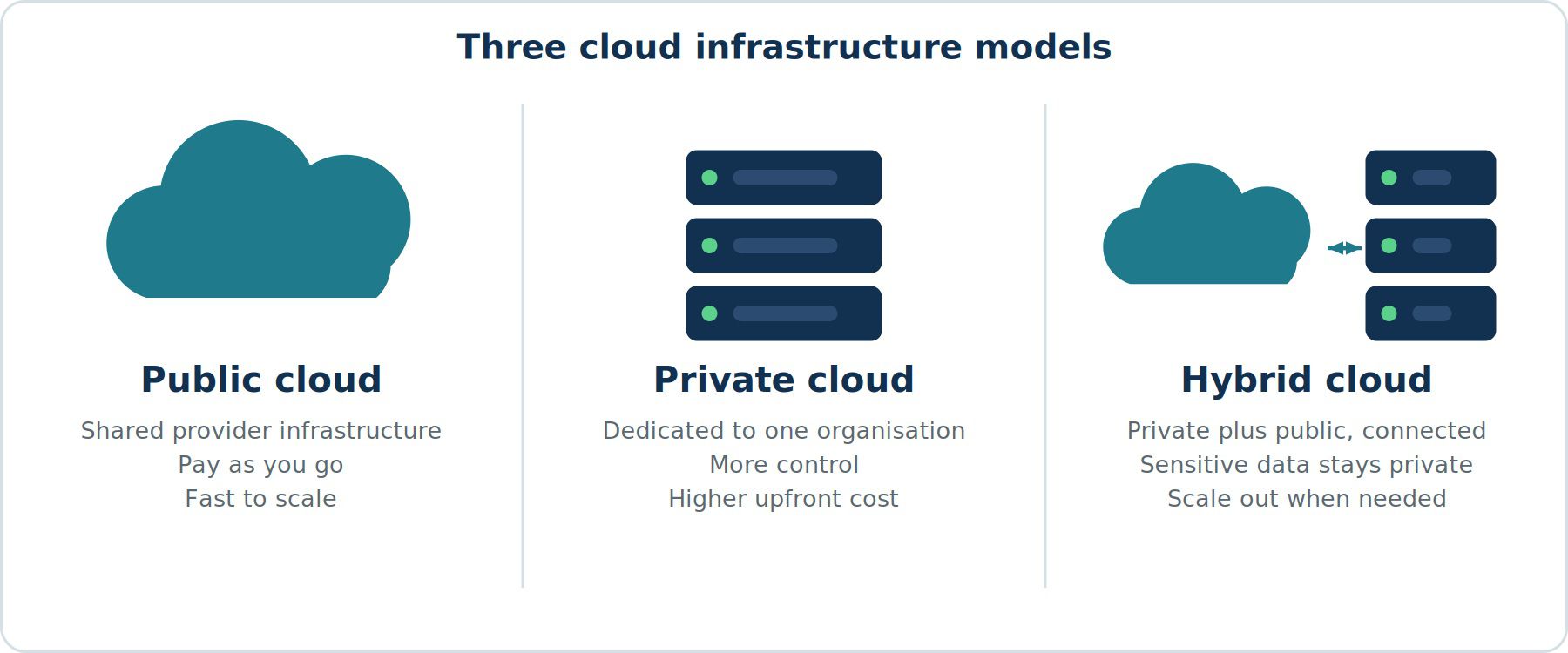
In a public cloud, a provider such as AWS, Microsoft Azure or Google Cloud owns and operates the infrastructure, and many customers share it. You rent resources on demand and pay for what you use.
Benefits: no hardware to buy, fast setup, easy scaling, a wide range of managed services and lower upfront cost.
Limitations: less control over the underlying infrastructure, costs that can grow if unmanaged and possible compliance questions for strictly regulated data.
Best suited to: startups, web applications, development and testing, and workloads with variable demand.
What Is Private Cloud?
A private cloud is infrastructure dedicated to a single organisation. It can be hosted in your own data centre or operated by a third party for your exclusive use.
Benefits: greater control over security, configuration and data location, and easier alignment with strict regulatory requirements.
Limitations: higher upfront investment, more responsibility for maintenance and slower scaling because capacity is limited by what you own.
Best suited to: organisations with strict compliance needs, sensitive data or predictable, steady workloads.
What Is Hybrid Cloud?
A hybrid cloud combines private infrastructure with public cloud services, with connectivity and orchestration between them. Workloads can run in the environment that suits them best.
Benefits: flexibility, the ability to keep sensitive data in a private environment while using public cloud scale for other workloads, and a gradual path for migrating from existing systems.
Limitations: more complex to design, secure and manage, and it requires skills across both environments.
Best suited to: businesses with existing data centres, mixed compliance needs or seasonal demand spikes.
Quick Summary of the Differences
- Control: private cloud gives the most, public cloud the least, hybrid sits in between.
- Upfront cost: public cloud is lowest, private cloud is highest.
- Scalability: public cloud scales fastest, private cloud is limited by owned capacity, and hybrid can burst into public cloud.
- Complexity: hybrid is usually the most complex to manage.
- Compliance fit: private and hybrid models often suit strict data requirements best.
How to Choose the Right Model
- Classify your data. Identify what is sensitive or regulated and what is not.
- Check regulatory requirements. Confirm any rules about where data must be stored.
- Review workload patterns. Variable workloads benefit from public cloud scaling, while steady ones can suit private infrastructure.
- Account for existing investments. If you have hardware you cannot yet retire, a hybrid approach may make financial sense.
- Assess your team's skills. Hybrid and private environments need strong operations expertise.
- Plan for change. Choose an approach that lets you adapt as the business grows.
What About Multi-Cloud?
Multi-cloud means using more than one public cloud provider. It is a different idea from hybrid, though the two are often combined. It can reduce dependence on one vendor, but it adds complexity, so it should be adopted for a clear reason.
Final Thoughts
There is no universally correct model. Most businesses should start from their data, compliance and workload needs, not from technology preferences. A cloud consultant can help you assess your situation and design a model that fits today and can evolve later.