
Choosing among cloud migration strategies is one of the most important decisions in any cloud project. The approach you pick affects cost, timeline, risk and how much value you get from the cloud afterwards. Three of the most common options are lift-and-shift, re-platform and re-architect. Here is how each works and how to choose.
What Is Lift-and-Shift (Rehost)?
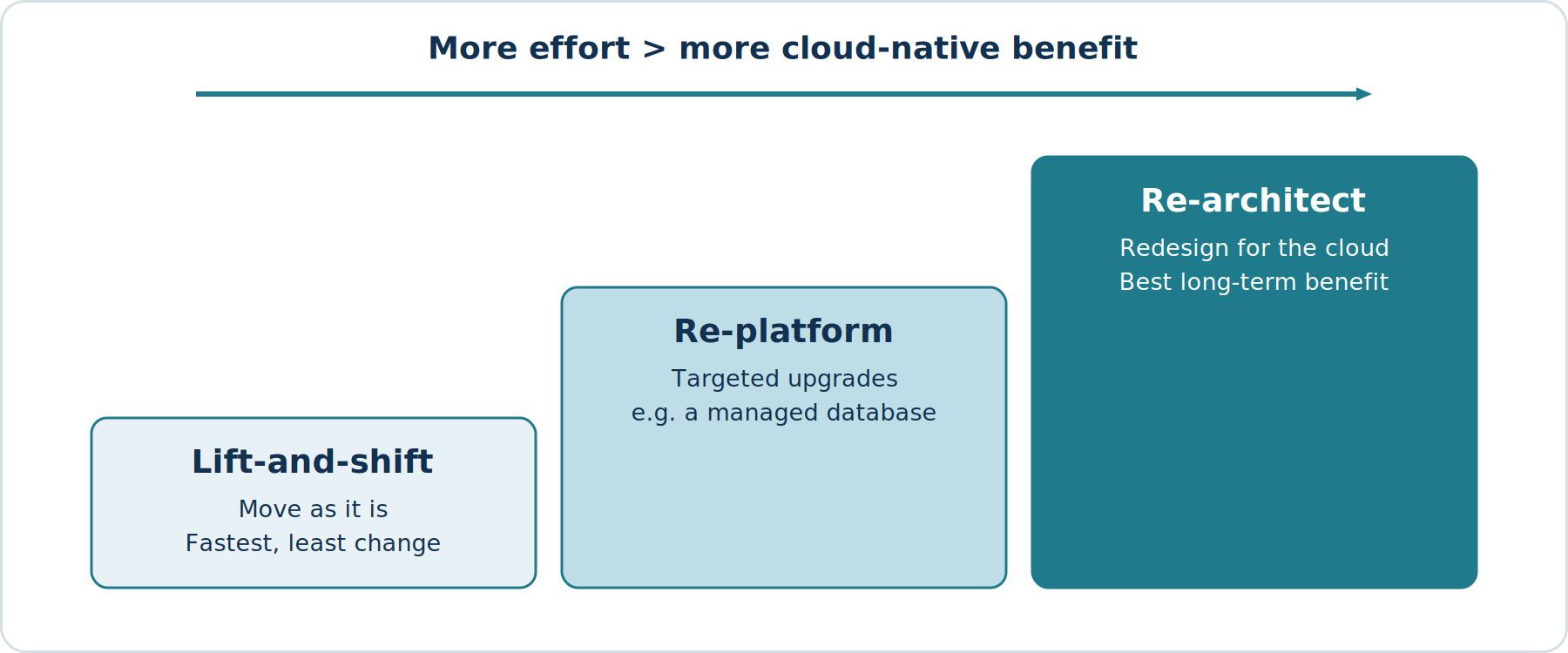
Lift-and-shift moves an application to the cloud with little or no change, typically from physical or virtual servers to cloud virtual machines. It is the fastest route and the least disruptive to the application itself.
Pros: quick to execute, low initial effort, minimal code changes, a good fit for tight deadlines such as a data centre exit.
Cons: the application does not take advantage of cloud-native features, so running costs can be higher than expected and scaling may remain limited.
What Is Re-Platform?
Re-platforming makes targeted improvements without rebuilding the application. A common example is moving a self-managed database to a managed database service, or moving an application onto a managed container or app platform.
Pros: reduces operational work such as patching and backups, improves reliability, moderate effort.
Cons: requires testing and some configuration changes, and still falls short of the full benefits of a cloud-native design.
What Is Re-Architect (Refactor)?
Re-architecting redesigns the application to use cloud-native capabilities such as microservices, serverless functions, managed messaging and automatic scaling.
Pros: best scalability, resilience and long-term cost efficiency, and faster feature delivery once complete.
Cons: the highest cost and longest timeline, needs strong engineering skills, and carries more delivery risk.
Side-by-Side Summary
- Speed: lift-and-shift is the fastest, re-platform is moderate and re-architect is the slowest.
- Upfront effort: low for lift-and-shift, medium for re-platform and high for re-architect.
- Cloud benefits: limited for lift-and-shift, moderate for re-platform and full for re-architect.
- Risk: lowest for lift-and-shift and highest for re-architect.
- Best for: lift-and-shift suits tight deadlines and legacy apps, re-platform suits reducing operations work, and re-architect suits core, growing applications.
How to Choose the Right Strategy
- Start with business priority. If speed matters most, rehost. If long-term growth matters most, consider re-architecting.
- Assess application value. Invest heavily only in applications that are strategic to the business.
- Check technical fit. Some legacy software cannot be modified or is not supported on cloud platforms, which limits your options.
- Consider your team's skills. A re-architecture needs cloud-native engineering experience.
- Think in phases. Many organisations rehost first, then re-platform or refactor later once the application is stable in the cloud.
Other Options Worth Knowing
Two more choices often appear in migration plans: retire applications nobody uses, and replace custom software with a ready-made SaaS product. Both can save significant effort compared with migrating everything.
Final Thoughts
There is no single best strategy. Most real migrations combine several approaches across different applications. Assess each workload against your goals, budget and risk tolerance, then choose the lightest approach that meets the need. A cloud partner can help you evaluate your portfolio and build a sensible migration roadmap.