
Moving to the cloud does not remove the need to manage infrastructure. Reliable performance depends on knowing how your systems are behaving, responding quickly to problems and planning ahead. Cloud infrastructure management covers the monitoring, maintenance and improvement of your cloud environment.
Why Monitoring and Management Matter
- Detect problems before customers notice them.
- Reduce downtime and speed up recovery.
- Keep performance steady as demand changes.
- Control costs by spotting waste.
- Support security and compliance with clear records.
What Should You Monitor?
- Infrastructure health: CPU, memory, disk and network usage for servers and containers.
- Application performance: response times, error rates and throughput.
- Availability: whether services and endpoints are reachable.
- Databases: query performance, connections and storage.
- Security events: logins, permission changes and unusual traffic.
- Cost and usage: spending trends and unexpected increases.
The Three Pillars of Observability
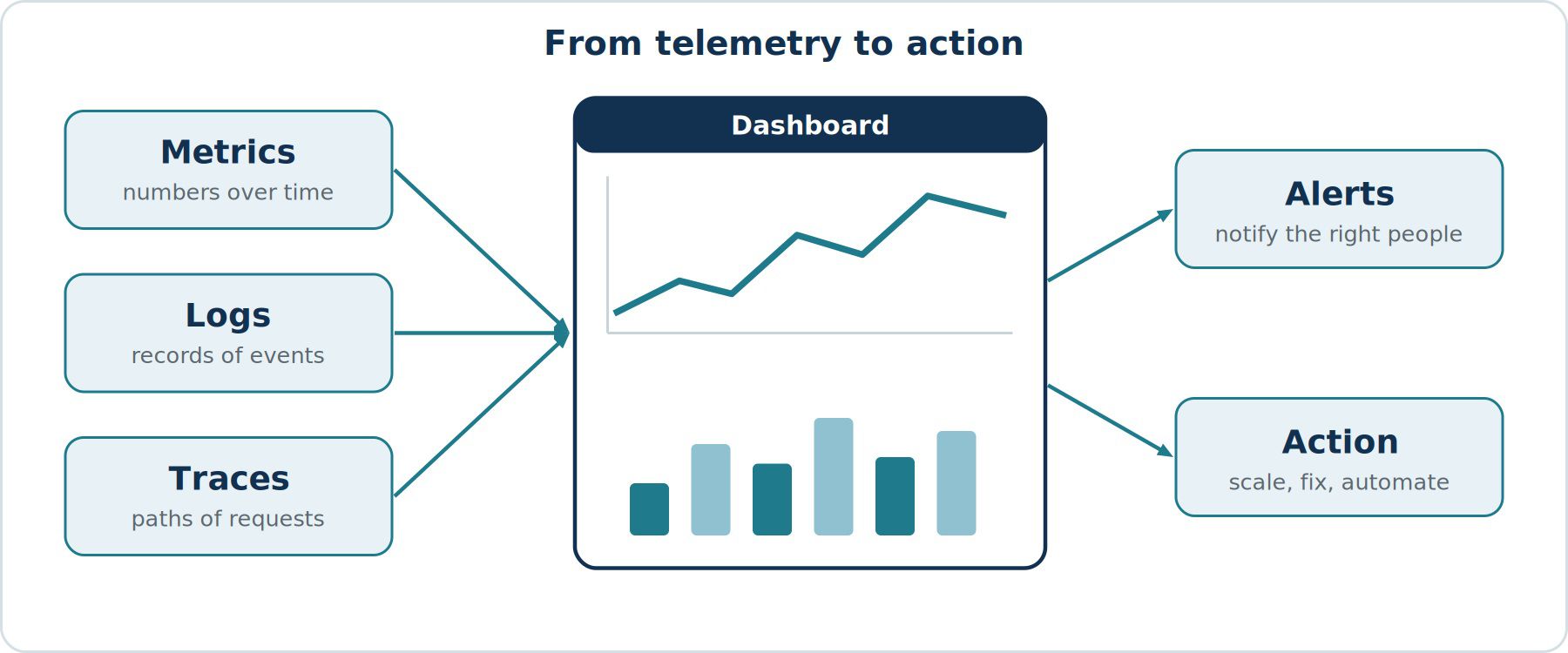
Modern teams often describe observability using three types of data: Metrics (numerical measurements over time, such as CPU usage or request counts), Logs (detailed records of events, useful for investigating what happened), and Traces (the path of a request through different services, useful for finding slow components).
Types of Monitoring Tools
- Native provider tools: services such as Amazon CloudWatch, Azure Monitor and Google Cloud Operations are built in and a good starting point.
- Open-source tools: Prometheus and Grafana are widely used for metrics and dashboards.
- Commercial platforms: products such as Datadog, New Relic and Dynatrace provide broad monitoring in a single service.
- Log management tools: tools such as the Elastic Stack help collect and search logs centrally.
Strategies for Reliable Performance
Set Meaningful Alerts
Alert on conditions that need action, not on every small fluctuation. Too many alerts cause fatigue and real problems get missed. Route alerts to the right people and define clear priorities.
Define Service Level Objectives
Agree measurable targets for availability and response time. Clear objectives help you decide what to monitor and when a problem is serious enough to act on immediately.
Plan Capacity
Use trend data to predict when you will need more resources, and use autoscaling where suitable to handle changes in demand automatically.
Automate Routine Tasks
Automate patching, backups, scaling and restarts where possible. Automation reduces manual effort and human error.
Build for Resilience
Spread critical systems across multiple availability zones, use load balancing and design applications to handle component failures gracefully.
Test Backups and Recovery
Regularly test that backups can be restored and that your recovery process works within the time you need.
Keep Documentation and Runbooks
Document how systems are built and write step-by-step runbooks for common incidents so that anyone on call can respond effectively.
Review Incidents and Improve
After any outage, hold a blameless review to understand what happened and what to change. Over time this builds a more reliable environment.
Final Thoughts
Good cloud infrastructure management combines the right visibility, sensible alerting, automation and regular review. Start with the basics, monitor what matters most to your business and improve step by step. If you do not have the in-house capacity, a managed cloud services provider can monitor and manage your environment for you.